The Other Subjects
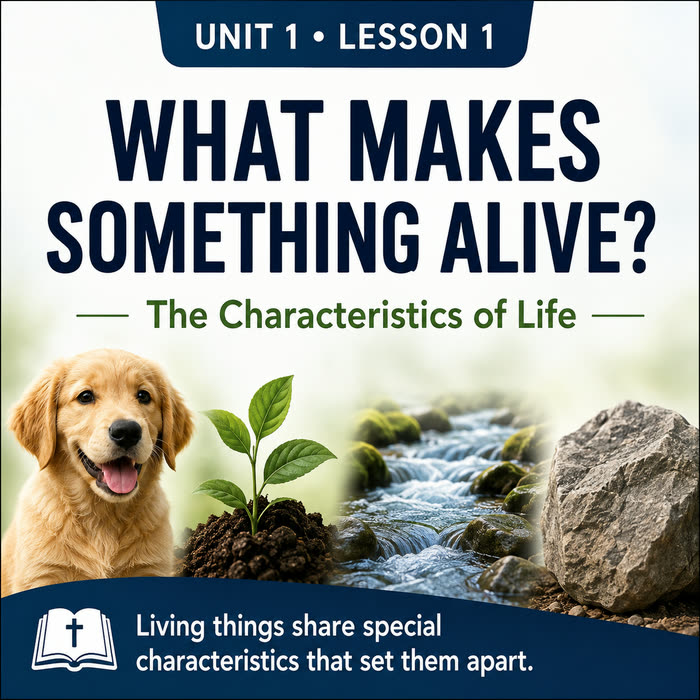 Science · Life Science · U1-L1
What Makes Something Alive
The characteristics every living thing shares, and what that complexity might point to.
Science · Life Science · U1-L1
What Makes Something Alive
The characteristics every living thing shares, and what that complexity might point to.
- A story-form reading, read aloud with the words highlighted
- Five vocabulary words, each one defined inside the reading
- Day 1: four questions with the answer findable in the text
- Day 2: a vocabulary check and a printable answer sheet
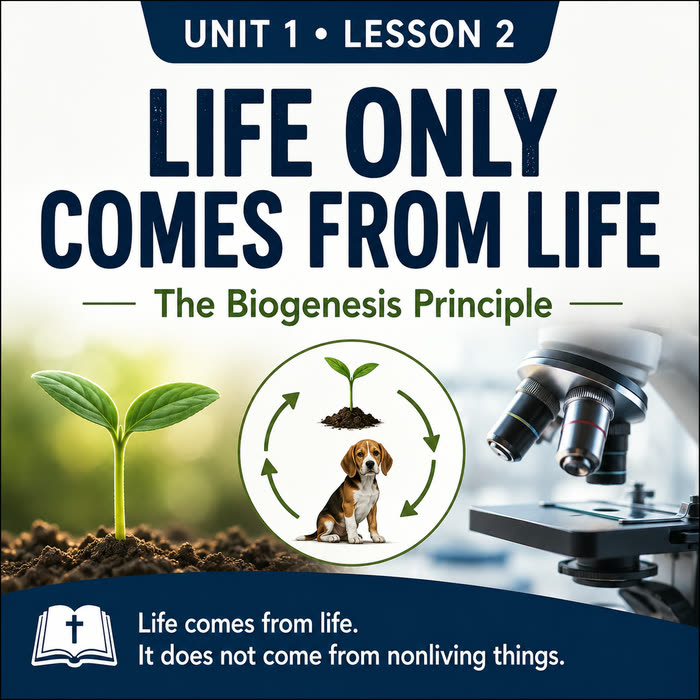 Science · Life Science · U1-L2
Life Only Comes From Life
Two experiments across two hundred years, and the question neither of them could reach.
Science · Life Science · U1-L2
Life Only Comes From Life
Two experiments across two hundred years, and the question neither of them could reach.
- A story-form reading, read aloud with the words highlighted
- Four vocabulary words, each one defined inside the reading
- Day 1: four questions with the answer findable in the text
- Day 2: a vocabulary check and a printable answer sheet
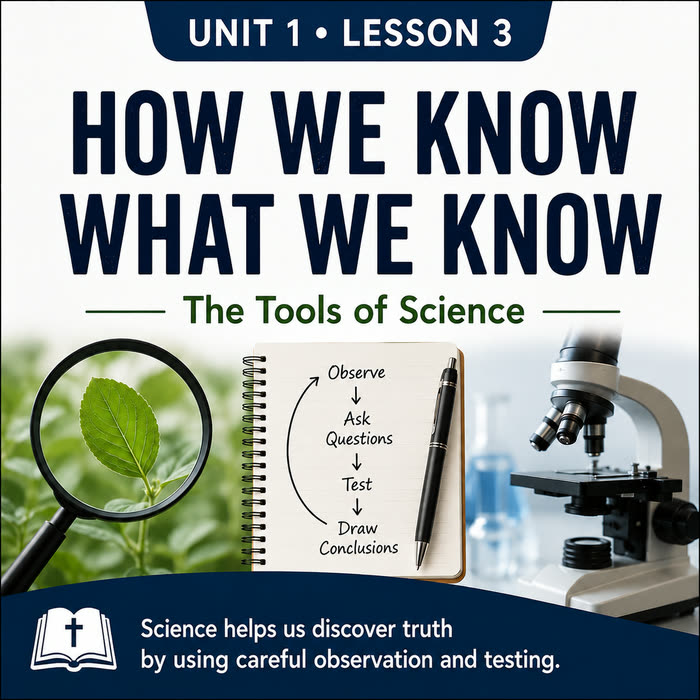 Science · Life Science · U1-L3
How We Know What We Know
Science is a method, not a pile of facts. What the method can settle, and what it cannot.
Science · Life Science · U1-L3
How We Know What We Know
Science is a method, not a pile of facts. What the method can settle, and what it cannot.
- A story-form reading, read aloud with the words highlighted
- Five vocabulary words, each one defined inside the reading
- Day 1: four questions with the answer findable in the text
- Day 2: a vocabulary check and a printable answer sheet
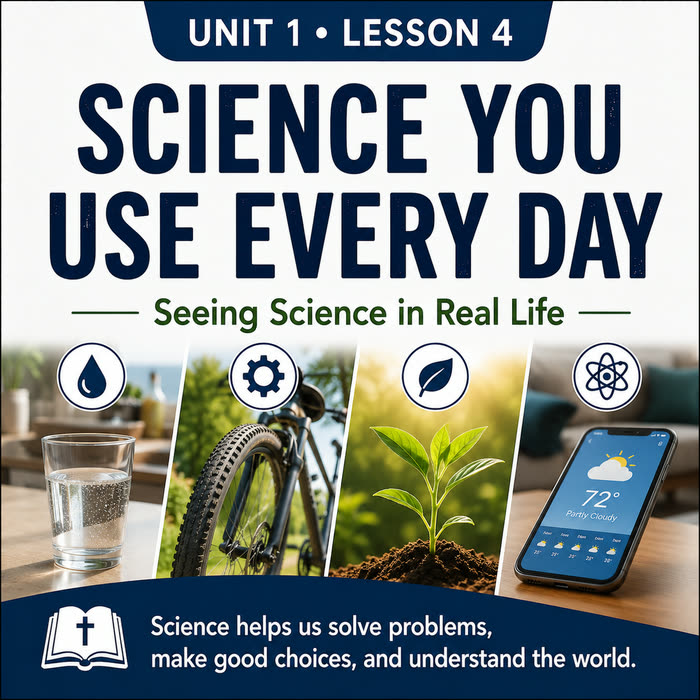 Science · Life Science · U1-L4
Science You Use Every Day
What the method has already done to your ordinary morning, and the choices it hands you.
Science · Life Science · U1-L4
Science You Use Every Day
What the method has already done to your ordinary morning, and the choices it hands you.
- A story-form reading, read aloud with the words highlighted
- Four vocabulary words, each one defined inside the reading
- Day 1: four questions with the answer findable in the text
- Day 2: a vocabulary check and a printable answer sheet
 Science · Life Science · U1-L5
Unit 1 Review: Life, Science, and How We Know
Four lessons back in one place, built around one question: how do you know that is why it happened?
Science · Life Science · U1-L5
Unit 1 Review: Life, Science, and How We Know
Four lessons back in one place, built around one question: how do you know that is why it happened?
- Two plants, one taller, and the difference between seeing it and explaining it
- The scientific method walked end to end on a single question about sunlight
- Redi, Pasteur, and an idea that sounded reasonable and was wrong
- Hypothesis, theory and law, and why a theory never becomes a law
 Science · Life Science · U2-L1
Cells: The Building Blocks of Life
Cells were inside every living thing long before anyone knew. This is the story of the tool that let us look.
Science · Life Science · U2-L1
Cells: The Building Blocks of Life
Cells were inside every living thing long before anyone knew. This is the story of the tool that let us look.
- A brick wall that turns into bricks as you walk toward it
- Hooke's cork, and why he called them cells when nothing in them was alive
- Leeuwenhoek finding things swimming in water that looked perfectly clear
- Why an electron microscope is not simply the better microscope
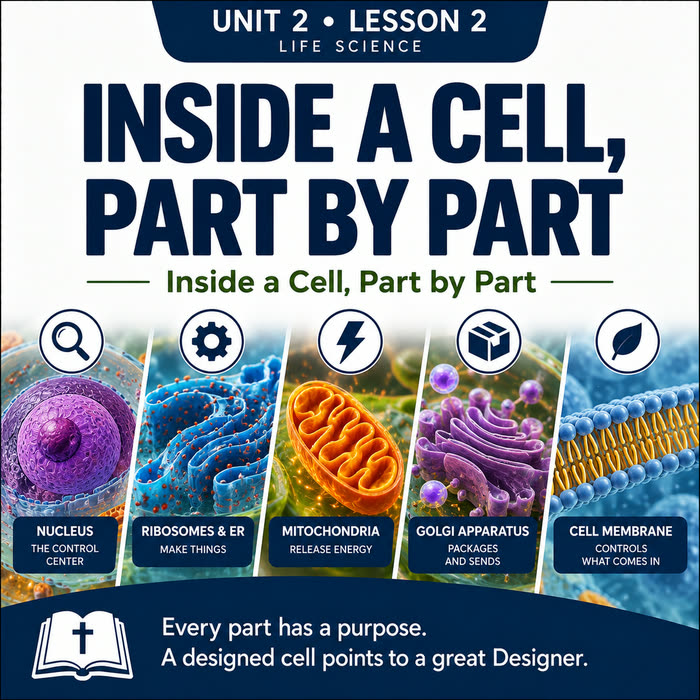 Science · Life Science · U2-L2
Inside a Cell, Part by Part
Walk into a warehouse and you can read everyone's job in thirty seconds. A cell is the same building, shrunk to the size of a pin head.
Science · Life Science · U2-L2
Inside a Cell, Part by Part
Walk into a warehouse and you can read everyone's job in thirty seconds. A cell is the same building, shrunk to the size of a pin head.
- A warehouse floor, and why nobody ever had to explain one to you
- The three things every cell that has ever been found has
- One question that splits every cell on earth into two kinds
- Proverbs 24, on a house whose chambers are filled
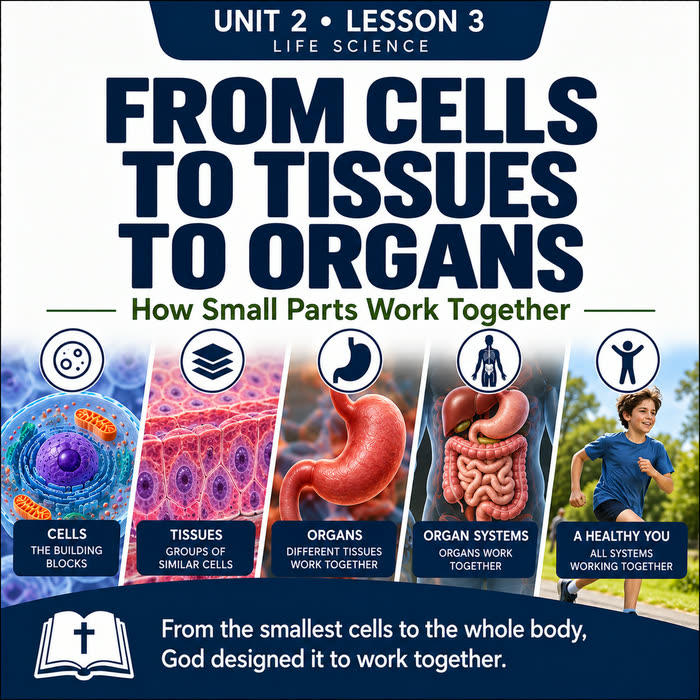 Science · Life Science · U2-L3
From Cells to Tissues to Organs
Cells are not all alike, and the shape of one usually tells you what it is for. Then how they stack up into a whole body.
Science · Life Science · U2-L3
From Cells to Tissues to Organs
Cells are not all alike, and the shape of one usually tells you what it is for. Then how they stack up into a whole body.
- A story-form reading, read aloud with the words highlighted
- Four vocabulary words, each one defined inside the reading
- The four rungs from a single cell up to a whole organism
- A vocabulary check and a printable answer sheet
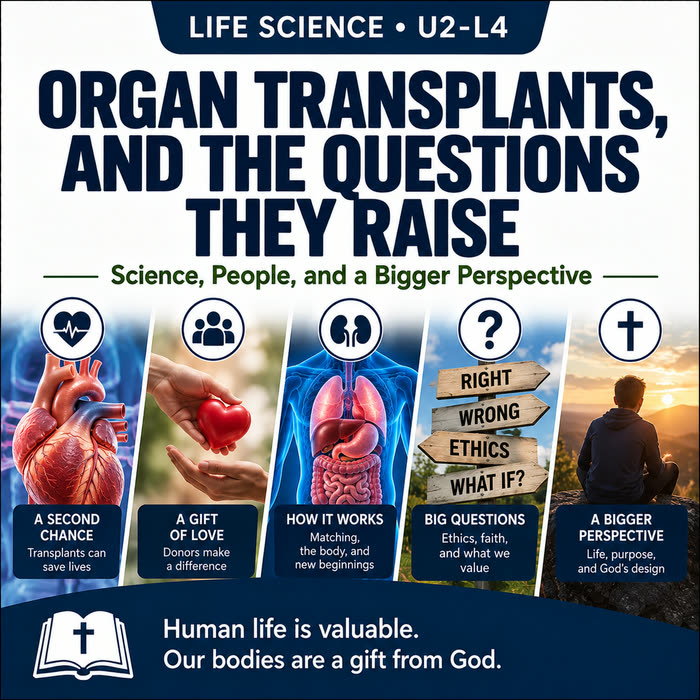 Science · Life Science · U2-L4
Organ Transplants, and the Questions They Raise
A kidney from one person can save the life of another, and sometimes the body refuses it. Why that happens, and what to do about how few organs there are.
Science · Life Science · U2-L4
Organ Transplants, and the Questions They Raise
A kidney from one person can save the life of another, and sometimes the body refuses it. Why that happens, and what to do about how few organs there are.
- A story-form reading, read aloud with the words highlighted
- Four words, each one defined inside the reading
- Four questions with the answer findable in the text
- A written argument to do in your notebook, with no right answer
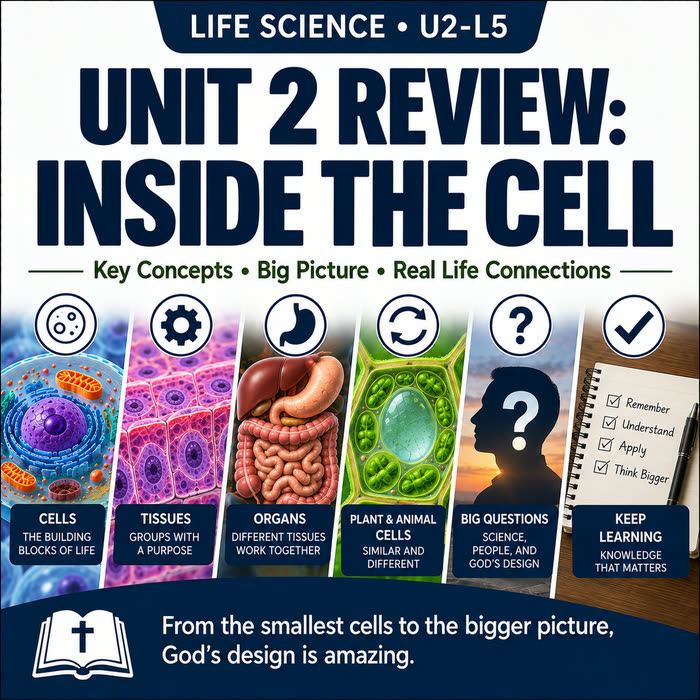 Science · Life Science · U2-L5
Unit 2 Review: Inside the Cell
The whole unit in one pass: the cell theory, the parts inside a cell, how cells team up into a body, and what happens when an organ moves from one person to another.
Science · Life Science · U2-L5
Unit 2 Review: Inside the Cell
The whole unit in one pass: the cell theory, the parts inside a cell, how cells team up into a body, and what happens when an organ moves from one person to another.
- The cell theory and the three things it says
- The parts of a cell, and which job belongs to which part
- Cells, tissues, organs and organ systems in order
- Two questions to answer in writing, with no answer key
Math · Math 7 · U1-L1
A Plan for Problem Solving
Four steps that work on any problem, including the ones nobody sets you.
- The four steps, explained one at a time as the lesson reads
- Two everyday problems worked all the way through, with every number typed
- An estimate you have to commit to before the page will let you calculate
- Fourteen questions, including one that can't be looked up
Math · Math 7 · U1-L2
Estimation Strategy: Using Rounding
Rounding turns a messy sum into a fast, close-enough answer you can trust.
- Mark's computer fund-raiser, rounded to the nearest hundred dollars
- The one rule that decides which way any digit rounds
- A grocery receipt checked for a cashier's mistake
- Twelve questions, including one straight off the book's own exercises
Math · Math 7 · U1-L3
Estimation Strategy: Using Patterns
One easy multiplication or division fact, stretched into an estimate for a much bigger one.
- 29,000 truckloads of rock, estimated with a pattern instead of long multiplication
- The different first move for estimating a quotient instead of a product
- Ub Iwerks and the 14,400 pictures he drew for Steamboat Willie
- Twelve questions, from small facts to genuinely large numbers
Math · Math 7 · U1-L4
Problem-Solving Strategy: Determine Reasonable Answers
A calculator can be wrong. Estimating first is how you catch it.
- Jordan's raise, checked against an estimate before trusting the calculator
- Two calculator answers that turn out to check out, and one that doesn't
- A grocery trip where rounding decides how much cash to bring
- Twelve questions built to catch the same kind of mistake a calculator can't
Math · Math 7 · U1-L5
Problem-Solving Strategy: Choose the Method of Computation
Two questions to ask before you touch the numbers, and why the same problem can need two different answers.
- The man who counted the cost before he built the tower, from Luke 14
- Caleb's 301 chairs, estimated once and counted exactly once
- Noah's notebooks, where the answer changes because the question did
- Eight questions that ask which method, never for the answer
Math · Math 7 · U1-L6
Problem-Solving Strategy: Classify Information
A word problem is a pile of facts in a paragraph. Sort them first, and one of them usually turns out not to matter.
- A youth-group van trip where one of the facts is not needed at all
- What Do I Know and What Do I Need to Find, written as two real lists
- Where classifying sits inside Explore, Plan, Solve, Examine
- Proverbs 18:13, on answering before you have heard the matter
Math · Math 7 · U1-L7
Order of Operations
Two students, one problem, two different answers. The order of operations is what settles the argument.
- 8 + 4 x 2 worked two ways, reaching 24 and 16
- The three levels, one section each, with the parentheses moved to show what changes
- Why multiplication does not always come before division
- One problem that uses all three levels, walked through a level at a time
Math · Math 7 · U1-L8
Variables and Expressions
A babysitter who can't quote a price until the night is over, and the letter that lets her write one anyway.
- A table of hours and pay, and the one column that never changes
- Why a letter can stand in for a number you don't know yet
- Evaluating an expression by handing the letter its number
- The short ways algebra writes multiply and divide
Math · Math 7 · U1-L9
Powers and Exponents
Why a number times itself is called squared, found on a bathroom floor, and the small raised number that saves you writing it out.
- A square of tiles, and where the word squared comes from
- Base, exponent and power, named on one example
- Writing a power out as a product, and a product as a power
- Where powers go in the order of operations
Math · Math 7 · U1-L10
Solving Equations Mentally
Tammy has $14 in an envelope and no idea how many hours it was for. An equation, a few good guesses, and one fact she already knew.
- An equation as a sentence that is true or false
- Why a letter makes it neither, until a number goes in
- Guess, check and adjust, with each miss pointing the way
- Equations you can solve from a fact you already know
Math · Math 7 · U1-L11
Unit 1 Review: Tools for Problem Solving
Ten lessons, one plan. Every tool from the unit, filed under the step of the four-step plan where you actually use it.
- Explore: sorting what you know from what you need
- Plan: choosing a method, rounding and patterns
- Solve: order of operations, variables, powers and equations
- Examine: catching an answer that can't be right
Math · Math 7 · U2-L1
Comparing and Ordering Decimals
An Olympic medal decided in the thousandths, a tie for bronze, and the one habit that tells you which decimal is bigger.
- Why further right on a number line means greater
- Lining up the decimal points and reading from the left
- Why a longer decimal isn't always a bigger one
- Putting four scores in order, tie included
Math · Math 7 · U2-L2
Rounding Decimals
A roller coaster clocked at 64.77 mph, a sign that says 65, and the one digit that decides which way a number rounds.
- Closer to 64 or 65? The number line answer
- The one-digit rule, and why it's the same rule you already know
- Rounding to tenths and hundredths
- The 9 that rounds up and leaves a zero behind
Math · Math 7 · U2-L3
Estimating with Decimals
A self-checkout total that's off by more than twenty dollars, and the ten-second estimate that catches it.
- Rounding each decimal before you add, subtract or multiply
- Clustering, when every number sits near the same value
- Estimating a quotient with patterns
- Using an estimate to catch a calculator mistake
Math · Math 7 · U2-L4
Multiplying Decimals
Every key on a piano is the one below it times about 1.06. Multiplying decimals, and two ways to know where the point goes.
- Multiplying as if the decimal points weren't there
- Placing the point with an estimate
- Placing the point by counting decimal places
- Why tenths times tenths lands in hundredths
Math · Math 7 · U2-L5
Powers of Ten
The moon is 2.39 times ten to the fifth miles away. How to turn that into a number you can say, in your head, in one move.
- The same number times 1, 10, 100, 1,000 and 10,000
- Why the point walks one place right for every zero
- Using the exponent to know how far to move it
- Adding zeros when you run out of digits
Math · Math 7 · U2-L6
Scientific Notation
Mercury is 36,000,000 miles from the sun, and nobody wants to count those zeros. Scientific notation, and back again.
- A number between 1 and 10, times a power of ten
- Moving the point left and counting the moves
- Rounding the front number to hundredths
- Turning it back into standard form to compare planets
Math · Math 7 · U2-L7
Dividing Decimals
A painting's area and width are known and its height isn't. Dividing by a decimal, and why moving both points keeps the answer the same.
- Making the divisor a whole number
- Moving both decimal points the same number of places
- Adding zeros when the digits run out
- Checking the quotient with an estimate
Math · Math 7 · U2-L8
Rounding Quotients
Four friends split a pizza and the calculator shows four decimal places. Rounding a quotient, and why money gets rounded up.
- Dividing one place past the place you're rounding to
- Rounding to the tenth, the hundredth and the whole number
- Why shared money is rounded up to the next cent
- Rounding to the greatest place value
Math · Math 7 · U2-L9
The Metric System
A runner's day is measured in meters, liters and grams, and each one comes in sizes that differ by 10, 100 and 1,000. Changing between them.
- The meter, the gram and the liter
- Prefixes as place values: kilo, hecto, deka, deci, centi, milli
- Multiplying to go to a smaller unit
- Dividing to go to a larger unit
Math · Math 7 · U2-L10
Determine Reasonable Answers
Marcus has $70, thinks he'll have $15 left after shopping, and a quick round-and-add says otherwise. Using an estimate to catch an answer that can't be right.
- The four-step plan: Explore, Plan, Solve, Examine
- Rounding prices to easy numbers
- Comparing an estimate with a claimed answer
- Telling a reasonable answer from one that can't be true
Math · Math 7 · U2-L11
Unit 2 Review: Applications with Decimals
Ten lessons, one habit. Every decimal tool from the unit, filed under the moment you use it: before you calculate, while you calculate, and after.
- Before: comparing, rounding and estimating
- During: multiplying, powers of ten, scientific notation, dividing and rounding a quotient
- After: metric units and checking whether an answer is reasonable
- A review with a hint that names the lesson to reopen
Math · Math 7 · U3-L1
Use a Graph
Bar graphs, double bar graphs, line graphs and circle graphs, and what to check before you trust any of them. The numbers are made up for practice.
- Reading the title, the axes and the key first
- A double bar graph, and what each color means
- A line graph and how to predict from a trend
- A circle graph of a budget
- Checking the scale before you answer
Math · Math 7 · U3-L2
Make a Table
Twenty answers to one survey question arrive in no order at all. How to tally them, count them and read them in a frequency table.
- Listing each possible answer once
- Tally marks and frequencies
- Reading a frequency table to answer questions
- Checking that the table adds up
Math · Math 7 · U3-L3
Range and Scales
Eleven students report the hours they spend on the phone. How far apart the numbers are, and how to draw a number line that fits every one of them.
- Finding the range
- Choosing a scale that holds all the data
- Choosing equal intervals
- Why more than one answer can be right
English · Literature · U1-L1
What Conflict Is
A mongoose, a cobra and a garden with room for only one of them: how to tell who is fighting whom.
- Teacher Notes written for whoever is teaching it
- The first half of Kipling's Rikki-Tikki-Tavi, read aloud one line at a time
- Four vocabulary cards, each with a check question
- Story questions that send you back to the line that answers them
English · Literature · U1-L2
Conflicts and the Hero
Three fights, one small mongoose, and the question of which one was hardest.
- Teacher Notes written for whoever is teaching it
- The second half of Kipling's Rikki-Tikki-Tavi, read aloud one line at a time
- Four vocabulary cards on Kipling's specific verbs, each with a check question
- Story questions that send you back to the line that answers them
- A one-paragraph written answer on paper
English · Literature · U1-L3
The Story Arc
A story builds like a triangle, and Rikki-tikki's fights fit on it one block at a time.
- Teacher Notes written for whoever is teaching it
- The four parts of a plot, filled in with Rikki-tikki-tavi's events
- Four vocabulary cards, each with a check question
- Questions that ask which part of the plot an event belongs to
- A plot triangle to draw and fill in on paper
English · Literature · U1-L4
What a Symbol Is
A frightened colt in the first snow, and the question of what else he might be.
- Teacher Notes written for whoever is teaching it
- Robert Frost's whole poem The Runaway, read aloud one line at a time
- Four vocabulary cards, each with a check question
- Questions that go from what the colt does to what he could stand for
- A quickwrite on paper about a time you learned something important
English · Literature · U1-L5
Finding the Theme
A duckling the whole farmyard says is wrong, and the three clues that tell you what the story is really about.
- Teacher Notes written for whoever is teaching it
- Hans Christian Andersen's whole story The Ugly Duckling, read aloud one line at a time
- Four vocabulary cards, each with a check question
- Story questions that walk the three steps for finding a theme
- A theme to write in one sentence on paper
English · Literature · U1-L6
Thinking About Your Reading
A boy the village tells to go to bed, a bear, and five steps for reading a story so you don't lose the thread.
- Teacher Notes written for whoever is teaching it
- Jack London's whole story The Story of Keesh, read aloud one line at a time
- Three stop points inside the story that name the reading step being used
- Four vocabulary cards, each with a check question
- A short written reflection on paper
English · Literature · U1-L7
Suspense and Foreshadowing
A dried-up paw, three wishes, and the clues that tell you what it's going to cost.
- Teacher Notes written for whoever is teaching it
- W. W. Jacobs's whole story The Monkey's Paw, read aloud one line at a time
- Two stop points where you predict and then check
- Four vocabulary cards, each with a check question
- A log of clues to fill in on paper
English · Literature · U1-L8
Reading a Character
A dollar and eighty-seven cents, a head of hair, and what a character's choices tell you without anyone saying it.
- Teacher Notes written for whoever is teaching it
- O. Henry's whole story The Gift of the Magi, read aloud one line at a time
- Two stop points where you make an inference out loud
- Four vocabulary cards, each with a check question
- Questions that give you a line and ask what it shows about the character
English · Literature · U1-L9
Writing a Short Story: Plan and Draft
Pick a character, give him something to fight, and build the plan before you write a word of the story.
- Teacher Notes written for whoever is teaching it
- The three prewriting decisions and the four-part story arc
- Four vocabulary cards, each with a check question
- Questions that check the steps and the arc
- A planning sheet and a story draft to write on paper
English · Literature · U1-L10
Writing a Short Story: Revise
Read your draft like a stranger, then find the pieces of sentences that never finished and fix them.
- Teacher Notes written for whoever is teaching it
- A checklist for revising a story draft
- How to find and fix sentence fragments
- Four vocabulary cards, each with a check question
- Practice questions on short sentences, then a revision of your own draft on paper
English · Literature · U1-L11
Unit 1 Review: The Short Story
One short story you haven't read and twelve questions on everything in the unit: conflict, plot, symbol, theme, clues, and character.
- Teacher Notes written for whoever is teaching it
- Saki's whole story The Open Window, read aloud one line at a time
- Twelve questions across conflict, the story arc, symbol, theme, foreshadowing and suspense, and character
- Four vocabulary cards for the unit's terms, each with a check question
English · Literature · U2-L1
Fact and Opinion in Autobiography
The day a deaf and blind girl found out that everything has a name, told by her, and a test for telling what's true from what's felt.
- Teacher Notes written for whoever is teaching it
- Helen Keller's account of the day her teacher came, read aloud one line at a time
- Four vocabulary cards, each with a check question
- Story questions that sort real sentences into fact and opinion
- A fact and an opinion to write from your own day, on paper
English · Literature · U2-L2
Kinds of Nonfiction
A seventeen-year-old with three rolls of bread, told by himself, told by a biographer, and told as plain facts. Five kinds of nonfiction, and the difference between facts and feelings.
- Teacher Notes written for whoever is teaching it
- Three samples of nonfiction, all about the same young man, read aloud one line at a time
- Four vocabulary cards, each with a check question
- Questions that name the kind of each sample and tell objective from subjective
- Two short tasks to do on your own, one with a relative and one on a silent walk
English · Literature · U2-L3
Comparing and Contrasting
Two sisters get ready for the same morning and end up in very different places. How to compare and contrast, the words that signal it, and the diagram that sorts it.
- Teacher Notes written for whoever is teaching it
- Mary Antin's account of her first morning at school in America, read aloud one line at a time
- Four vocabulary cards, each with a check question
- Story questions about likenesses, differences and signal words
- A compare-and-contrast paragraph to write on paper
English · Literature · U2-L4
Description and Word Choice
A sleeping river town wakes up when a steamboat appears, told by a boy who wanted to be a steamboatman. How writers use the senses and the exact word to make you see and hear it.
- Teacher Notes written for whoever is teaching it
- Mark Twain's account of a steamboat arriving, read aloud one line at a time
- Four vocabulary cards, each with a check question
- Story questions about the senses and the exact word
- A short description to write from your own place, on paper
English · Literature · U2-L5
Main Idea, Stated or Implied
A boy starts school with no cap and only one name, and his mother and his own quick thinking solve both. How to find the main idea, whether the writer says it or you have to.
- Teacher Notes written for whoever is teaching it
- Booker T. Washington's account of his first days at school, read aloud one line at a time
- Four vocabulary cards, each with a check question
- Story questions about stated and implied main ideas
- A main idea and two supporting details to write from your own reading, on paper
Science · Life Science · U3-L1
What Living Things Are Made Of
Everything you're made of is built from a small handful of pieces. Start with the atom and climb to the four kinds of molecules that make up every living thing.
- A story-form reading, read aloud with the words highlighted
- Nine words, each one defined inside the reading
- Six questions with the answer findable in the text
- Five vocabulary questions on the word cards
Science · Life Science · U3-L2
How Things Get In and Out of a Cell
A cell has to let food in and push waste out without letting in everything else. How it chooses, and what it costs.
- A story-form reading, read aloud with the words highlighted
- Eight vocabulary words, each one defined inside the reading
- Four questions with the answer findable in the text
- A vocabulary check and a printable answer sheet
Science · Life Science · U3-L3
Where a Cell Gets Its Energy
Every bit of energy in your body was sunlight first. The steps in between, and what each one is called.
- A story-form reading, read aloud with the words highlighted
- Six vocabulary words, each one defined inside the reading
- Four questions with the answer findable in the text
- A vocabulary check and a printable answer sheet
Science · Life Science · U3-L4
What We Throw Away, and Where It Goes
Some things rot away and some things do not. Which is which, why it matters, and what you think should be done about it.
- A story-form reading, read aloud with the words highlighted
- Four vocabulary words, each one defined inside the reading
- Four questions with the answer findable in the text
- A written argument to do in your notebook, with no right answer
Science · Life Science · U3-L5
Unit 3 Review: How Cells Work
The whole unit in one pass: what a living thing is built from, how things get into a cell, where its energy comes from, and what happens to what we throw away.
- Atoms, compounds and the four organic groups
- Diffusion, osmosis, and which crossings cost energy
- Photosynthesis and cellular respiration as one loop
- Two questions to answer in writing, with no answer key
Science · Life Science · U4-L1
How a Cell Grows and Divides
Right now, while you read this, parts of you are splitting in two. How one cell becomes two, and why both get exactly the same instructions.
- A story-form reading, read aloud with the words highlighted
- The five stages of mitosis in order, with a way to remember them
- How plant and animal cells split differently
- Fission, budding and regeneration as mitosis doing a bigger job
Science · Life Science · U4-L2
Two Parents, and How Traits Combine
Every cell in you has 46 chromosomes, and you started from two cells. So why don't you have 92? Meiosis, and the halving that makes a new life possible.
- A story-form reading, read aloud with the words highlighted
- Why sex cells carry half the chromosomes
- Meiosis: two divisions, four cells
- Fertilization and the zygote
Science · Life Science · U4-L3
DNA: The Instructions Inside
A photograph nobody asked permission to show, a spiral staircase, and the four-letter code that tells every cell in you what to build.
- A story-form reading, read aloud with the words highlighted
- Rosalind Franklin, and the photograph that cracked DNA
- The four bases, and the partner each one always takes
- How DNA copies itself, and how a gene becomes a protein
Science · Life Science · U4-L4
Engineering Living Things, and Where the Line Is
Scientists can move a gene from one living thing into another, and in 1988 someone patented the result. What that means, and a question you'll have to answer yourself.
- A story-form reading, read aloud with the words highlighted
- What a transgenic organism is, with the book's real examples
- The benefits and the worries, side by side
- A You Decide question to answer in writing, with no answer key
Science · Life Science · U4-L5
Unit 4 Review: How Cells Make More Cells
The whole unit in one pass: how a cell divides, how two parents each pass on half a set, how DNA holds the instructions, and how genes get moved on purpose.
- Mitosis, and asexual against sexual reproduction
- Meiosis, fertilization and the zygote
- DNA, RNA, genes and mutations
- Transgenic organisms
- Two questions to answer in writing, with no answer key
Science · Life Science · U5-L1
Why You Look Like Your Parents
A monk with a pea garden, a trait that vanishes and comes back at exactly three to one, and the grid that explains it.
- Mendel's garden and his tall and short peas
- Alleles, dominant and recessive
- Genotype and phenotype, homozygous and heterozygous
- How to fill in and read a Punnett square
Science · Life Science · U5-L2
What We Learned After Mendel
A red flower and a white flower make a pink one, a blood type has three possible alleles, and nobody's height is simply tall or short. Three patterns Mendel's peas didn't show.
- Incomplete dominance, and why nothing blends away
- Multiple alleles and the ABO blood types
- Polygenic traits like height and eye color
- How to tell which pattern a trait follows
Science · Life Science · U5-L3
Traits, Disorders, and Human Genetics
Who decides whether a baby's a boy or a girl, why color blindness shows up more in boys, and how two healthy parents can pass on a disorder without having done anything wrong.
- XX and XY, and the one-in-two chance each child
- Sex-linked traits like red-green color blindness
- Reading a pedigree, a family chart of a trait
- Sickle-cell anemia and cystic fibrosis, and what a carrier is
Science · Life Science · U5-L4
Mapping the Human Genome
Scientists set out to find and read every gene a person has. What the map is, what it's good for, who might misuse it, and a question you'll have to answer in writing.
- A story-form reading, read aloud with the words highlighted
- What a genome is, with the railroad-map comparison
- What the finished map turned out to say, including where the 1994 book guessed wrong
- A real benefit and a real risk, side by side
- A You Decide question to answer in writing, with no answer key
Science · Life Science · U5-L5
Unit 5 Review: How Traits Pass Down
The whole unit in one pass: how alleles pass down, the patterns Mendel didn't see, how sex and some disorders are inherited, and what the genome map means.
- Alleles, dominant and recessive, and a Punnett square worked in words
- Incomplete dominance, multiple alleles and polygenic traits
- Sex determination, carriers and family charts
- The Human Genome Project
- A question to answer in writing, with no answer key
Science · Life Science · U6-L1
What Evolution Claims, and What It Rests On
Seventy seeds turn into nearly two hundred million, a young man sails to the Galapagos, and a question nobody watched. What can be seen happening, and what is a claim about the beginning.
- A story-form reading, read aloud with the words highlighted
- Variation, overproduction and natural selection, and a real measured example
- Lamarck's idea, and why it was set aside
- Two views of how fast change goes
- The origin question, with both answers given in their own words
- Sorting statements into what's been observed and what's a claim about origins
Math · Integers · U7-L4
Adding Integers
Two rules cover every case. Which one you use depends on whether the signs match.
- Teacher Notes: the exact mistake to watch for, and what to say
- Two examples walked through a step at a time, read aloud
- The sign rules as a chart you can check an answer against
- Fifteen problems, new ones every day, in practice and test modes
Math · Integers · U7-L5
Subtracting Integers
No new arithmetic. Turn it into an addition, then use the rules you already have.
- Teacher Notes: why this is one step and not two
- Two examples walked through a step at a time, read aloud
- Keep, Change, Change, with the rewrite typed before the answer
- Fifteen problems, new ones every day, in practice and test modes