 Life Science · U1-L1
What Makes Something Alive
The characteristics every living thing shares, and what that complexity might point to.
- A story-form reading, read aloud with the words highlighted
- Five vocabulary words, each one defined inside the reading
- Day 1: four questions with the answer findable in the text
- Day 2: a vocabulary check and a printable answer sheet
 Life Science · U1-L2
Life Only Comes From Life
Two experiments across two hundred years, and the question neither of them could reach.
- A story-form reading, read aloud with the words highlighted
- Four vocabulary words, each one defined inside the reading
- Day 1: four questions with the answer findable in the text
- Day 2: a vocabulary check and a printable answer sheet
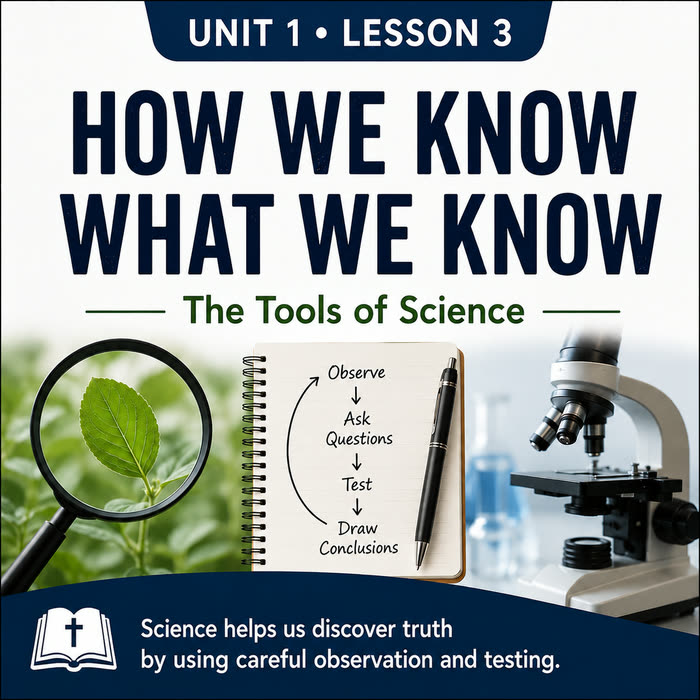 Life Science · U1-L3
How We Know What We Know
Science is a method, not a pile of facts. What the method can settle, and what it cannot.
- A story-form reading, read aloud with the words highlighted
- Five vocabulary words, each one defined inside the reading
- Day 1: four questions with the answer findable in the text
- Day 2: a vocabulary check and a printable answer sheet
 Life Science · U1-L4
Science You Use Every Day
What the method has already done to your ordinary morning, and the choices it hands you.
- A story-form reading, read aloud with the words highlighted
- Four vocabulary words, each one defined inside the reading
- Day 1: four questions with the answer findable in the text
- Day 2: a vocabulary check and a printable answer sheet
 Life Science · U1-L5
Unit 1 Review: Life, Science, and How We Know
Four lessons back in one place, built around one question: how do you know that is why it happened?
- Two plants, one taller, and the difference between seeing it and explaining it
- The scientific method walked end to end on a single question about sunlight
- Redi, Pasteur, and an idea that sounded reasonable and was wrong
- Hypothesis, theory and law, and why a theory never becomes a law
 Life Science · U2-L1
Cells: The Building Blocks of Life
Cells were inside every living thing long before anyone knew. This is the story of the tool that let us look.
- A brick wall that turns into bricks as you walk toward it
- Hooke's cork, and why he called them cells when nothing in them was alive
- Leeuwenhoek finding things swimming in water that looked perfectly clear
- Why an electron microscope is not simply the better microscope
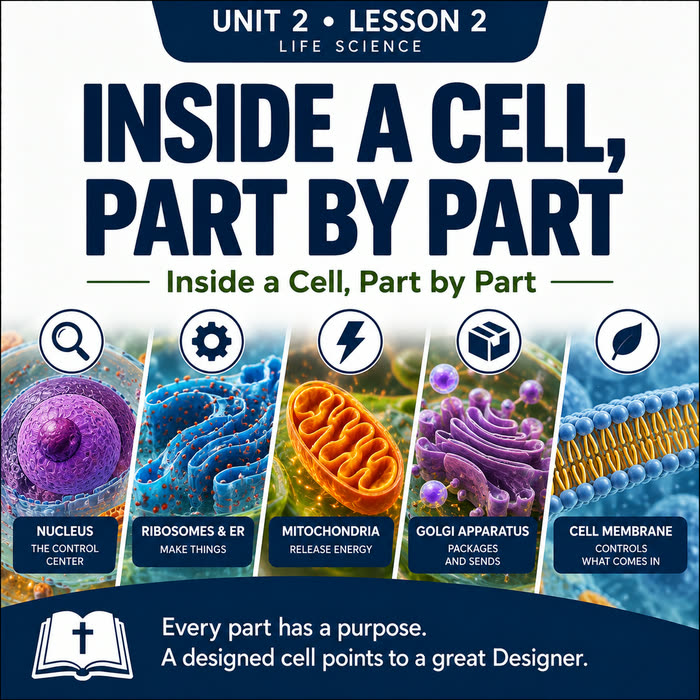 Life Science · U2-L2
Inside a Cell, Part by Part
Walk into a warehouse and you can read everyone's job in thirty seconds. A cell is the same building, shrunk to the size of a pin head.
- A warehouse floor, and why nobody ever had to explain one to you
- The three things every cell that has ever been found has
- One question that splits every cell on earth into two kinds
- Proverbs 24, on a house whose chambers are filled
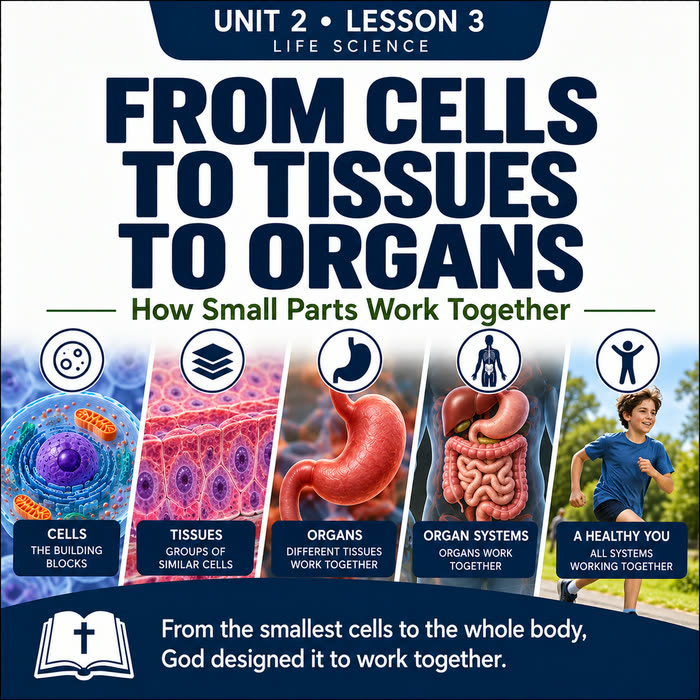 Life Science · U2-L3
From Cells to Tissues to Organs
Cells are not all alike, and the shape of one usually tells you what it is for. Then how they stack up into a whole body.
- A story-form reading, read aloud with the words highlighted
- Four vocabulary words, each one defined inside the reading
- The four rungs from a single cell up to a whole organism
- A vocabulary check and a printable answer sheet
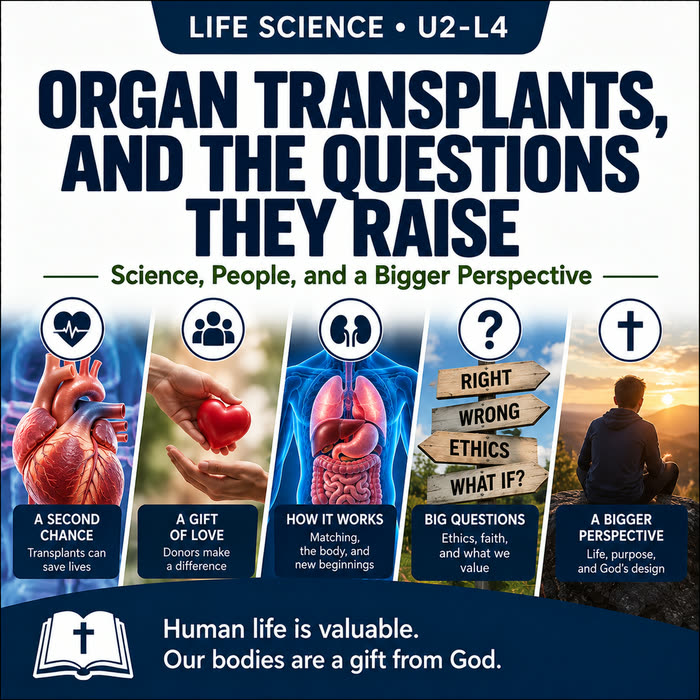 Life Science · U2-L4
Organ Transplants, and the Questions They Raise
A kidney from one person can save the life of another, and sometimes the body refuses it. Why that happens, and what to do about how few organs there are.
- A story-form reading, read aloud with the words highlighted
- Four words, each one defined inside the reading
- Four questions with the answer findable in the text
- A written argument to do in your notebook, with no right answer
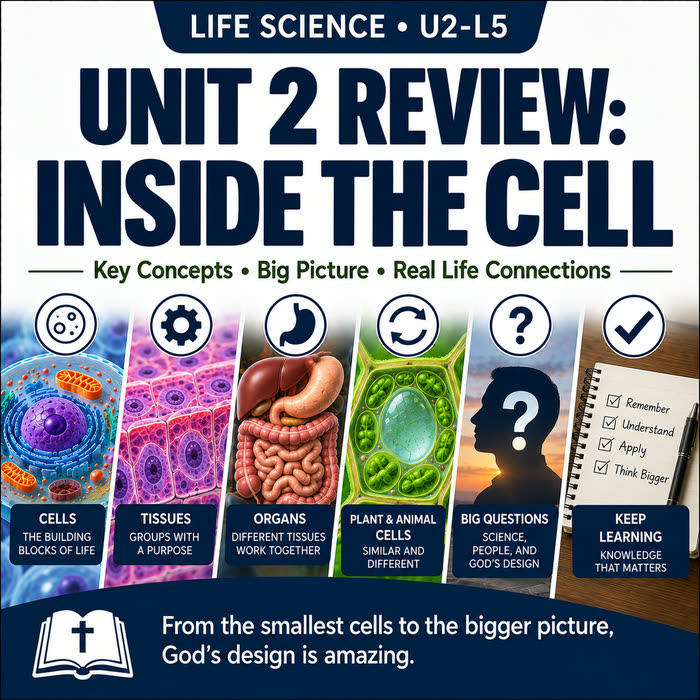 Life Science · U2-L5
Unit 2 Review: Inside the Cell
The whole unit in one pass: the cell theory, the parts inside a cell, how cells team up into a body, and what happens when an organ moves from one person to another.
- The cell theory and the three things it says
- The parts of a cell, and which job belongs to which part
- Cells, tissues, organs and organ systems in order
- Two questions to answer in writing, with no answer key
Life Science · U3-L1
What Living Things Are Made Of
Everything you're made of is built from a small handful of pieces. Start with the atom and climb to the four kinds of molecules that make up every living thing.
- A story-form reading, read aloud with the words highlighted
- Nine words, each one defined inside the reading
- Six questions with the answer findable in the text
- Five vocabulary questions on the word cards
Life Science · U3-L2
How Things Get In and Out of a Cell
A cell has to let food in and push waste out without letting in everything else. How it chooses, and what it costs.
- A story-form reading, read aloud with the words highlighted
- Eight vocabulary words, each one defined inside the reading
- Four questions with the answer findable in the text
- A vocabulary check and a printable answer sheet
Life Science · U3-L3
Where a Cell Gets Its Energy
Every bit of energy in your body was sunlight first. The steps in between, and what each one is called.
- A story-form reading, read aloud with the words highlighted
- Six vocabulary words, each one defined inside the reading
- Four questions with the answer findable in the text
- A vocabulary check and a printable answer sheet
Life Science · U3-L4
What We Throw Away, and Where It Goes
Some things rot away and some things do not. Which is which, why it matters, and what you think should be done about it.
- A story-form reading, read aloud with the words highlighted
- Four vocabulary words, each one defined inside the reading
- Four questions with the answer findable in the text
- A written argument to do in your notebook, with no right answer
Life Science · U3-L5
Unit 3 Review: How Cells Work
The whole unit in one pass: what a living thing is built from, how things get into a cell, where its energy comes from, and what happens to what we throw away.
- Atoms, compounds and the four organic groups
- Diffusion, osmosis, and which crossings cost energy
- Photosynthesis and cellular respiration as one loop
- Two questions to answer in writing, with no answer key
Life Science · U4-L1
How a Cell Grows and Divides
Right now, while you read this, parts of you are splitting in two. How one cell becomes two, and why both get exactly the same instructions.
- A story-form reading, read aloud with the words highlighted
- The five stages of mitosis in order, with a way to remember them
- How plant and animal cells split differently
- Fission, budding and regeneration as mitosis doing a bigger job
Life Science · U4-L2
Two Parents, and How Traits Combine
Every cell in you has 46 chromosomes, and you started from two cells. So why don't you have 92? Meiosis, and the halving that makes a new life possible.
- A story-form reading, read aloud with the words highlighted
- Why sex cells carry half the chromosomes
- Meiosis: two divisions, four cells
- Fertilization and the zygote
Life Science · U4-L3
DNA: The Instructions Inside
A photograph nobody asked permission to show, a spiral staircase, and the four-letter code that tells every cell in you what to build.
- A story-form reading, read aloud with the words highlighted
- Rosalind Franklin, and the photograph that cracked DNA
- The four bases, and the partner each one always takes
- How DNA copies itself, and how a gene becomes a protein
Life Science · U4-L4
Engineering Living Things, and Where the Line Is
Scientists can move a gene from one living thing into another, and in 1988 someone patented the result. What that means, and a question you'll have to answer yourself.
- A story-form reading, read aloud with the words highlighted
- What a transgenic organism is, with the book's real examples
- The benefits and the worries, side by side
- A You Decide question to answer in writing, with no answer key
Life Science · U4-L5
Unit 4 Review: How Cells Make More Cells
The whole unit in one pass: how a cell divides, how two parents each pass on half a set, how DNA holds the instructions, and how genes get moved on purpose.
- Mitosis, and asexual against sexual reproduction
- Meiosis, fertilization and the zygote
- DNA, RNA, genes and mutations
- Transgenic organisms
- Two questions to answer in writing, with no answer key
Life Science · U5-L1
Why You Look Like Your Parents
You got your looks from your parents, one copy of every instruction from each. What genes are, which copy wins, and the grid that predicts it.
- What a gene is, and why you have two copies of each one
- Dominant and recessive: which copy shows when they disagree
- Mendel's peas and the trait that skipped a generation
- A Punnett square built one step at a time
Life Science · U5-L2
What We Learned After Mendel
A red flower and a white flower make a pink one, a blood type comes from three possible alleles, and nobody's height is simply tall or short. Three patterns Mendel's peas didn't show, each one drawn out.
- A quick recap of genes, alleles and the Punnett square
- Incomplete dominance: two flower crosses drawn step by step
- Multiple alleles: all six blood-type pairs in a table, and one cross
- Polygenic traits like height, and how to tell the three patterns apart
Life Science · U5-L3
Traits, Disorders, and Human Genetics
Who decides whether a baby's a boy or a girl, why color blindness shows up more in boys, and how two healthy parents can pass on a disorder without having done anything wrong. Every idea is drawn out.
- A quick recap of genes, alleles and recessive
- XX and XY drawn as a square, and the one-in-two chance each child
- Sex-linked traits like color blindness, and a family chart (pedigree)
- Cystic fibrosis and what a carrier is, drawn as a square
Life Science · U5-L4
Mapping the Human Genome
Scientists set out to find and read every gene a person has. A quick recap of DNA, genes and chromosomes, what the map looks like, and what it's good for, with a question you'll answer in writing.
- A recap of DNA, genes and chromosomes, drawn as a zoom
- What a genome map is, with the railroad-map comparison drawn out
- What a base pair is, drawn as a DNA ladder
- What the finished map found, against what scientists first guessed
- One benefit, one risk, and a You Decide question with no answer key
Life Science · U5-L5
Unit 5 Review: How Traits Pass Down
The whole unit in one pass, with every cross drawn again: how alleles pass down, the patterns Mendel didn't see, how sex and some disorders are inherited, and what the genome map means.
- Alleles, dominant and recessive, and a Punnett square drawn again
- Incomplete dominance, blood type and polygenic traits
- Sex determination, a carrier mother, a family chart and a disorder that needs two copies
- The Human Genome Project in one paragraph
- A question to answer in writing, with no answer key
Life Science · U6-L1
What Evolution Claims, and What It Rests On
Seventy seeds turn into nearly two hundred million, a young man sails to the Galapagos, and a question nobody watched. Darwin's four ideas listed, a finch story told step by step, and what can be seen happening against what is a claim about the beginning.
- The pumpkin math, worked out step by step
- Variation, population and species in plain words
- Darwin's four ideas, listed with an example each
- The 1977 finch drought, step by step
- Lamarck's idea, and why it was set aside
- Two answers to the origin question, in their own words
- Sorting statements into what's been observed and what's a claim about origins
Life Science · U6-L2
The Evidence, Examined Honestly
A couple on a Texas lakeshore pick up an odd rock, and it turns out to be a monster's skull. How rock layers and a candle-like clock work, and what people take the finds to mean.
- What a fossil is, with a jar of muddy water for the picture
- Rock layers drawn as a stack, and how to read them step by step
- A rock clock explained with a candle
- The same bones in an arm, a flipper and two kinds of wings
- What was found against what it is taken to mean
- Both answers to the skull puzzle, in their own words
Life Science · U6-L3
Extinction, and Caring for What Remains
The last passenger pigeon dies in a zoo in 1914. Why kinds of living things die out, how people have sped it up, and two ways to fight back.
- What extinction is, in plain words
- Four causes sorted into natural and added by people
- Two ways to save an endangered species, drawn as a table
- What it means to look after what you've been given
Life Science · U6-L4
Human Origins: Two Accounts, Side by Side
Touch your thumb to each fingertip and you've done a test that sorts you with the monkeys. Then a skull in a quarry, a skeleton called Lucy, and a question about what the bones mean.
- What primates share, in plain words
- The main fossils in one table, built a row at a time
- Sorting what was found from what is claimed
- Both accounts of where people came from, side by side in a table
Life Science · U6-L5
Unit 6 Review: Origins: Evolution and Creation, Side by Side
The whole unit in one pass, with pictures: what natural selection does, how rock layers and a rock clock work, why species die out, and what's been found about primates, with what was found kept apart from what it's taken to mean.
- Natural selection, replayed with the finches
- A stack of rock layers and a candle clock
- Extinction, and the two ways to save a species
- Primates and the fossils
- Both answers to the origin question, side by side one more time
- A question to answer in writing, with no answer key
Life Science · U7-L1
Why We Sort Living Things
A trip to the zoo raises a problem nobody can answer without a system: is it a bird or an insect, a monkey or a bear? How people learned to sort living things, and how every organism got a two-word name.
- Why we classify, and Aristotle's two kingdoms
- Where Aristotle's system broke down, drawn as a table
- Linnaeus and the two-word scientific name
- Building a scientific name one rule at a time
- Why scientific names use Latin
Life Science · U7-L2
How Scientists Classify Today
A music store sorts its albums by type, then artist, then title, and scientists sort living things the same way. Five kingdoms, seven levels, and one wolf taken all the way down.
- Four questions that sort living things into five kingdoms
- What a nucleus is, and cells with one and without one
- The five kingdoms in a table, built a row at a time
- The seven levels as a ladder, with one wolf sorted down it
- Two readings of what the groups mean, side by side
- A note on how today's books sometimes count the kingdoms differently
Life Science · U7-L3
The Rain Forest, and What Is Being Lost
Fifty acres of rain forest are cut down every minute, and most of what lives there has never been named. What's being lost, who depends on it, and a hard question with two real sides.
- A story-form reading, read aloud with the words highlighted
- How fast the rain forest is being cleared, and what lives there
- Two dangerous effects: the air and the weather
- The people who live there and need the land
- The book's hard question, with both sides laid out
- What it means to look after the earth
Life Science · U7-L4
Identifying an Organism Yourself
Three different birds all get called a robin, and a starfish isn't a fish. How scientific names keep everyone talking about the same animal, and how a key can name an animal you've never seen.
- Why common names confuse, and what a scientific name fixes
- A dichotomous key drawn as numbered pairs, built a pair at a time
- Using the key on a pill bug and a slug, one pair at a time
- Making a key of your own, with four pets as the practice
- What it means to ask the animals and the earth to teach you
Life Science · U7-L5
Unit 7 Review: Sorting and Naming Living Things
The whole unit in one pass: why we sort living things, how to write a scientific name, the five kingdoms, the seven levels, and a key that names an animal you have never seen.
- Why we sort, and how a scientific name is written
- The four questions and the five kingdoms
- The seven levels, with a red fox taken all the way down
- A small dichotomous key, used one pair at a time
- The rain forest in one line
- A paragraph and a table to write on your own, with no answer key
Life Science · U8-L1
Viruses: Alive, or Not?
A virus isn't a cell, can't eat or grow, and can sit in a jar for years, yet it can make you sick. What a virus is, the four steps of an infection, and how a vaccine stops one.
- Why a virus is on the edge of what counts as alive
- What a virus is made of, and its shapes
- The four steps of an active infection, built a step at a time
- A virus that hides, like a cold sore
- How a vaccine works, with Jenner and the milkmaids
- A virus that helps, like an ambulance for DNA
Life Science · U8-L2
What It Costs to Cure a Disease
Why doesn't every disease have a cure yet? How a germ can switch off the body's guards, how a new medicine gets tested for years before anyone can buy it, and the hard question of where limited money should go.
- The immune system, the body's guards
- How HIV weakens the guards, one step at a time
- How it spreads and how it does not
- How a medicine goes from an idea to the pharmacy
- Why testing takes years and costs so much
- The book's You Decide question, with both sides fairly stated
Life Science · U8-L3
Bacteria, the Kingdom Monera
A shovelful of soil holds billions of them, and hundreds of thousands live on you right now. What a bacterium is made of, how it divides, and how a pond full of tiny green cells can kill the fish.
- Why bacteria are everywhere, and why most are harmless
- The parts of one bacterium and what each does
- Three shapes, and how a bacterium divides in two
- Breathers and non-breathers: aerobes and anaerobes
- Cyanobacteria, the ones that make their own food
- A pond bloom, one link at a time, and why you boil the water after a flood
Life Science · U8-L4
The Bacteria You Live With Every Day
Bacteria make your yogurt, feed the peas in the garden and clean up oil spills, and a few can make you very sick. Which is which, and why botulism goes with a sealed can.
- The bacteria in your food
- Nature's cleanup crew, and bacteria that feed plants
- Bacteria that eat pollution
- Pathogens and toxins
- How antibiotics and pasteurization fight harmful bacteria
- Why botulism goes with a sealed can and not fresh food
Life Science · U8-L5
Unit 8 Review: The Smallest Living Things
The whole unit in one pass: what a virus is and how it gets into a cell, how a medicine goes from an idea to the pharmacy, the simple cells called monerans, and the bacteria that help and harm us.
- The four lessons in one table
- A virus taken through its four steps again
- The five steps a new medicine takes
- Counting bacteria in a serving of yogurt
- Vaccines, antibiotics and pasteurization, and what each is for
- Two paragraphs to write on your own, with no answer key
Life Science · U9-L1
Protists: The Odd Ones Out
If it isn't a plant, an animal or a fungus, it's probably a protist. The odd group that includes pond scum, the germ of malaria and the mold behind the Irish potato famine.
- Why protists are called the misfits
- The six kinds of algae, built a row at a time
- Four animal-like protists, sorted by how they move
- Slime molds and water molds, and the Irish potato famine
- Sorting three new organisms into the three groups
Life Science · U9-L2
Fungi, and What They Break Down
A mushroom, the black fuzz on old bread and the yeast in a loaf are all fungi. Fungi can't make food and don't move, so what do they do? They digest dead things, and the world would be buried without them.
- What all fungi share, and their job as nature's recyclers
- How a fungus eats, one step at a time
- Spores, and the four kinds of fungi sorted with a small key
- How yeast makes bread rise
- Lichens, two living things in one body
- Why you never eat a wild mushroom
Life Science · U9-L3
Why We Could Not Live Without Fungi
Before the 1940s a bad bacterial infection could kill you. A mold on an orange changed that, and fungi have been making medicine ever since. What they make, what goes wrong, and why some say preventing a disease beats curing it.
- What life was like before antibiotics
- What an antibiotic is, and why penicillin comes from a mold
- Why a medicine can stop working on bacteria
- The first drug against a virus, and the drug that helps transplants
- Prevent or cure, an argument with two real sides
- Six word cards, each with a check question
Life Science · U9-L4
Unit 9 Review: Protists and Fungi
The whole unit in one pass: the odd living things called protists, the fungi that break down what has died, and the medicines that fungi make.
- The sorting test, tried on three mystery living things
- Protists sorted by how they move
- How a fungus eats, taken through its four steps again
- The four kinds of fungi and how each makes spores
- Fungus medicines in one table
- Notebook questions from the book, with no answer key