Grammar · U4-L14
Kinds of Sentences
Four kinds of sentences, four different jobs, and the one case where the punctuation lies to you.
- Teacher Notes written for whoever is teaching it
- The lesson read aloud, one line at a time, highlighted as it goes
- Four vocabulary cards, each with a check question
- Ten questions, including the command that ends in an exclamation point
Grammar · U4-L14
Writing Good Sentences
Two ways to make an already-correct sentence better: mixing up the types you use, and breaking apart the ones that ramble on too long.
- Teacher Notes written for whoever is teaching it
- The lesson read aloud, one line at a time, highlighted as it goes
- Three vocabulary cards, each with a check question
- Ten questions on revising sentences, not just naming them
Grammar · U4-L8
Finding the Subject
Most sentences say the subject first, and then a sentence turns around and hides it. Find it anyway.
- Teacher Notes written for whoever is teaching it
- The lesson read aloud, one line at a time, highlighted as it goes
- A panel that shows each example sentence as you hear it
- Three vocabulary cards, each with a check question
- Eight questions on finding a hidden subject
Grammar · U4-L13
Conjunctions
One small word decides whether the cook makes one bowl or two. And, but, or, and the pairs that hold ideas together even tighter.
- Teacher Notes written for whoever is teaching it
- The lesson read aloud, one line at a time, highlighted as it goes
- A panel that shows each example sentence as you hear it
- Three vocabulary cards, each with a check question
- Eight questions on choosing and finding conjunctions
Grammar · U4-L16
Fragments and Run-ons
A note on the fridge that leaves Mom with more questions than answers. Finding the missing piece of a fragment, and where a run-on should have stopped.
- Teacher Notes written for whoever is teaching it
- The lesson read aloud, one line at a time, highlighted as it goes
- A panel that shows each example sentence as you hear it
- Three vocabulary cards, each with a check question
- Eight questions on spotting and fixing fragments and run-ons
Grammar · U4-L9
Forming Compound and Complex Sentences
A campaign speech where every sentence is fine and the whole thing sounds like a robot. Joining short sentences so they sound like a person.
- Teacher Notes written for whoever is teaching it
- The lesson read aloud, one line at a time, highlighted as it goes
- A panel that shows each example sentence as you hear it
- Four vocabulary cards, each with a check question
- Eight questions on combining sentences
Grammar · U4-L17
Unit 1 Review: The Sentence
A poster about wetlands full of mistakes. Fixing it takes every skill in the unit, one sentence at a time.
- Teacher Notes written for whoever is teaching it
- The lesson read aloud, one line at a time, highlighted as it goes
- One real poster to proofread, with a checklist
- Questions that each point back to the lesson to reread
Grammar · U4-L1
Kinds of Nouns
A boy from Quincy, Illinois, a homemade radio, and an invention whose name you'll probably guess. Sorting every noun two ways.
- Teacher Notes written for whoever is teaching it
- The lesson read aloud, one line at a time, highlighted as it goes
- Concrete and abstract nouns, common and proper nouns
- Four vocabulary cards, each with a check question
Grammar · U4-L3
Collective and Compound Nouns
A crowd, a band and a crew watch the fastest ocean liner ever built leave New York. Words for groups, and words made of other words.
- Teacher Notes written for whoever is teaching it
- The lesson read aloud, one line at a time, highlighted as it goes
- Collective nouns, and the three ways compound nouns are written
- Three vocabulary cards, each with a check question
Literature · U1-L1
What Conflict Is
A mongoose, a cobra and a garden with room for only one of them: how to tell who is fighting whom.
- Teacher Notes written for whoever is teaching it
- The first half of Kipling's Rikki-Tikki-Tavi, read aloud one line at a time
- Four vocabulary cards, each with a check question
- Story questions that send you back to the line that answers them
Literature · U1-L2
Conflicts and the Hero
Three fights, one small mongoose, and the question of which one was hardest.
- Teacher Notes written for whoever is teaching it
- The second half of Kipling's Rikki-Tikki-Tavi, read aloud one line at a time
- Four vocabulary cards on Kipling's specific verbs, each with a check question
- Story questions that send you back to the line that answers them
- A one-paragraph written answer on paper
Literature · U1-L3
The Story Arc
A story builds like a triangle, and Rikki-tikki's fights fit on it one block at a time.
- Teacher Notes written for whoever is teaching it
- The four parts of a plot, filled in with Rikki-tikki-tavi's events
- Four vocabulary cards, each with a check question
- Questions that ask which part of the plot an event belongs to
- A plot triangle to draw and fill in on paper
Literature · U1-L4
What a Symbol Is
A frightened colt in the first snow, and the question of what else he might be.
- Teacher Notes written for whoever is teaching it
- Robert Frost's whole poem The Runaway, read aloud one line at a time
- Four vocabulary cards, each with a check question
- Questions that go from what the colt does to what he could stand for
- A quickwrite on paper about a time you learned something important
Literature · U1-L5
Finding the Theme
A duckling the whole farmyard says is wrong, and the three clues that tell you what the story is really about.
- Teacher Notes written for whoever is teaching it
- Hans Christian Andersen's whole story The Ugly Duckling, read aloud one line at a time
- Four vocabulary cards, each with a check question
- Story questions that walk the three steps for finding a theme
- A theme to write in one sentence on paper
Literature · U1-L6
Thinking About Your Reading
A boy the village tells to go to bed, a bear, and five steps for reading a story so you don't lose the thread.
- Teacher Notes written for whoever is teaching it
- Jack London's whole story The Story of Keesh, read aloud one line at a time
- Three stop points inside the story that name the reading step being used
- Four vocabulary cards, each with a check question
- A short written reflection on paper
Literature · U1-L7
Suspense and Foreshadowing
A dried-up paw, three wishes, and the clues that tell you what it's going to cost.
- Teacher Notes written for whoever is teaching it
- W. W. Jacobs's whole story The Monkey's Paw, read aloud one line at a time
- Two stop points where you predict and then check
- Four vocabulary cards, each with a check question
- A log of clues to fill in on paper
Literature · U1-L8
Reading a Character
A dollar and eighty-seven cents, a head of hair, and what a character's choices tell you without anyone saying it.
- Teacher Notes written for whoever is teaching it
- O. Henry's whole story The Gift of the Magi, read aloud one line at a time
- Two stop points where you make an inference out loud
- Four vocabulary cards, each with a check question
- Questions that give you a line and ask what it shows about the character
Literature · U1-L9
Writing a Short Story: Plan and Draft
Pick a character, give him something to fight, and build the plan before you write a word of the story.
- Teacher Notes written for whoever is teaching it
- The three prewriting decisions and the four-part story arc
- Four vocabulary cards, each with a check question
- Questions that check the steps and the arc
- A planning sheet and a story draft to write on paper
Literature · U1-L10
Writing a Short Story: Revise
Read your draft like a stranger, then find the pieces of sentences that never finished and fix them.
- Teacher Notes written for whoever is teaching it
- A checklist for revising a story draft
- How to find and fix sentence fragments
- Four vocabulary cards, each with a check question
- Practice questions on short sentences, then a revision of your own draft on paper
Literature · U1-L11
Unit 1 Review: The Short Story
One short story you haven't read and twelve questions on everything in the unit: conflict, plot, symbol, theme, clues, and character.
- Teacher Notes written for whoever is teaching it
- Saki's whole story The Open Window, read aloud one line at a time
- Twelve questions across conflict, the story arc, symbol, theme, foreshadowing and suspense, and character
- Four vocabulary cards for the unit's terms, each with a check question
Literature · U2-L1
Fact and Opinion in Autobiography
The day a deaf and blind girl found out that everything has a name, told by her, and a test for telling what's true from what's felt.
- Teacher Notes written for whoever is teaching it
- Helen Keller's account of the day her teacher came, read aloud one line at a time
- Four vocabulary cards, each with a check question
- Story questions that sort real sentences into fact and opinion
- A fact and an opinion to write from your own day, on paper
Literature · U2-L2
Kinds of Nonfiction
A seventeen-year-old with three rolls of bread, told by himself, told by a biographer, and told as plain facts. Five kinds of nonfiction, and the difference between facts and feelings.
- Teacher Notes written for whoever is teaching it
- Three samples of nonfiction, all about the same young man, read aloud one line at a time
- Four vocabulary cards, each with a check question
- Questions that name the kind of each sample and tell objective from subjective
- Two short tasks to do on your own, one with a relative and one on a silent walk
Literature · U2-L3
Comparing and Contrasting
Two sisters get ready for the same morning and end up in very different places. How to compare and contrast, the words that signal it, and the diagram that sorts it.
- Teacher Notes written for whoever is teaching it
- Mary Antin's account of her first morning at school in America, read aloud one line at a time
- Four vocabulary cards, each with a check question
- Story questions about likenesses, differences and signal words
- A compare-and-contrast paragraph to write on paper
Literature · U2-L4
Description and Word Choice
A sleeping river town wakes up when a steamboat appears, told by a boy who wanted to be a steamboatman. How writers use the senses and the exact word to make you see and hear it.
- Teacher Notes written for whoever is teaching it
- Mark Twain's account of a steamboat arriving, read aloud one line at a time
- Four vocabulary cards, each with a check question
- Story questions about the senses and the exact word
- A short description to write from your own place, on paper
Literature · U2-L5
Main Idea, Stated or Implied
A boy starts school with no cap and only one name, and his mother and his own quick thinking solve both. How to find the main idea, whether the writer says it or you have to.
- Teacher Notes written for whoever is teaching it
- Booker T. Washington's account of his first days at school, read aloud one line at a time
- Four vocabulary cards, each with a check question
- Story questions about stated and implied main ideas
- A main idea and two supporting details to write from your own reading, on paper
Literature · U2-L6
Setting and Sensory Details
A man walks into seventy-five below zero and doesn't think much of it. Setting, the five senses, and how a place can push a story along.
- Jack London's To Build a Fire, in short excerpts, read aloud one line at a time
- A worked example that sorts details into the five senses
- Four vocabulary cards, each with a check question
- Questions on the story and on lines you haven't seen
- A real place described with all five senses, on paper
Literature · U2-L7
Figures of Speech
A poet says it's dreary to be somebody, and compares fame to a frog. Simile, metaphor, and how to tell them apart.
- Emily Dickinson's I'm Nobody, the whole poem, read aloud one line at a time
- Two worked examples that classify a comparison step by step
- Four vocabulary cards, each with a check question
- Questions on the poem and on lines you haven't seen
- A simile and a metaphor of your own, on paper
Literature · U2-L8
Holding a Group Discussion
Four students, one story and fifteen minutes to agree on what it means. The five steps that turn four opinions into one answer.
- A model discussion you read as dialogue, one step at a time
- The moderator, the recorder and why roles come first
- Brainstorming and reaching a consensus
- Four vocabulary cards, each with a check question
- A short family discussion to hold on your own
Literature · U2-L9
Writing About Your Life: Plan and Draft
A boy in Baltimore hides a book and a piece of bread on his errands. How to pick one event from your own life, plan it in four parts and write the first draft.
- Frederick Douglass learning to read, in short excerpts, read aloud one line at a time
- A worked example that fills a four-part plan from the model
- Four vocabulary cards, each with a check question
- Questions on the model and on lines you haven't seen
- A plan and a first draft of your own, on paper
Literature · U2-L10
Writing About Your Life: Revise
A draft that reads like a robot, and how two small changes make it sound like a person. The six checks for your own story, and how to join short sentences.
- The six checks for a good autobiographical incident
- A worked example that joins two choppy sentences step by step
- Independent and subordinate clauses, and the comma rule
- Four vocabulary cards, each with a check question
- Your own draft revised, on paper
Literature · U2-L11
Unit 2 Review: Autobiography and Nonfiction
One passage you haven't read, from a famous naturalist's boyhood, and fourteen questions on everything in the unit: fact and opinion, kinds of nonfiction, comparing, description, main idea, setting and figures of speech.
- Teacher Notes written for whoever is teaching it
- Three paragraphs from John Muir's autobiography, read aloud one line at a time
- Fourteen questions across the seven skills of the unit
- Four vocabulary cards for the unit's terms, each with a check question
Literature · U3-L1
Foreshadowing and Internal Conflict
Two old friends promise to meet on a street corner in twenty years. How to find the clues a writer hides, and how to read a character who is pulled two ways at once.
- Teacher Notes written for whoever is teaching it
- O. Henry's whole story After Twenty Years, read aloud one line at a time
- A second reading that finds each clue and says what it hints
- A look at the struggle inside one character's mind
- Seven word cards, each with a check question
Literature · U3-L2
Point of View
The same moment told three ways. Two questions that tell you who is narrating and how much of a character's mind you get to see.
- Teacher Notes written for whoever is teaching it
- One scene retold in first person, third-person limited and omniscient
- A walk that sorts three passages with two questions
- A chart of the three kinds to keep
- Five word cards, each with a check question
Literature · U3-L3
Predictions and Flashback
Stop, guess, read on, and check. A scene from Dickens' A Christmas Carol where a ghost carries an old man back into his own boyhood.
- Teacher Notes written for whoever is teaching it
- An excerpt from Charles Dickens' A Christmas Carol, read aloud one line at a time
- Three stop points where you make a prediction and then check it
- What a flashback is and why a writer uses one
- Six word cards, each with a check question
Literature · U3-L4
Third-Person Limited Point of View
A nine-year-old girl in the woods has a secret worth ten dollars. What it means when a story stays inside one character's head.
- Teacher Notes written for whoever is teaching it
- An excerpt from Sarah Orne Jewett's A White Heron, read aloud one line at a time
- A sort of which lines are inside her mind
- A look at what the reader can't know, and a rewrite from another view
- Six word cards, each with a check question
Literature · U3-L5
Tone
Say "You're a big help" two ways and it means two opposite things. How to hear a writer's tone, with a poem by Paul Laurence Dunbar about a smile that hides something.
- Teacher Notes written for whoever is teaching it
- Three words said two ways, and what tone and sarcasm are
- A poem by Paul Laurence Dunbar, read aloud one line at a time
- Three stops where you go from the clue words to the tone
- Tone against mood, named once
- Six word cards, each with a check question
Literature · U3-L6
First-Person Narrator and History
A boy named Jim tells you about the strange old sailor who came to stay at his family's inn. How to spot a first-person narrator, and how to collect clues and draw a conclusion about a character.
- Teacher Notes written for whoever is teaching it
- What first person is, and what a narrator can't know
- An excerpt from Robert Louis Stevenson's Treasure Island, read aloud one line at a time
- Four stops where you go from evidence to conclusion
- What historical fiction is
- Six word cards, each with a check question
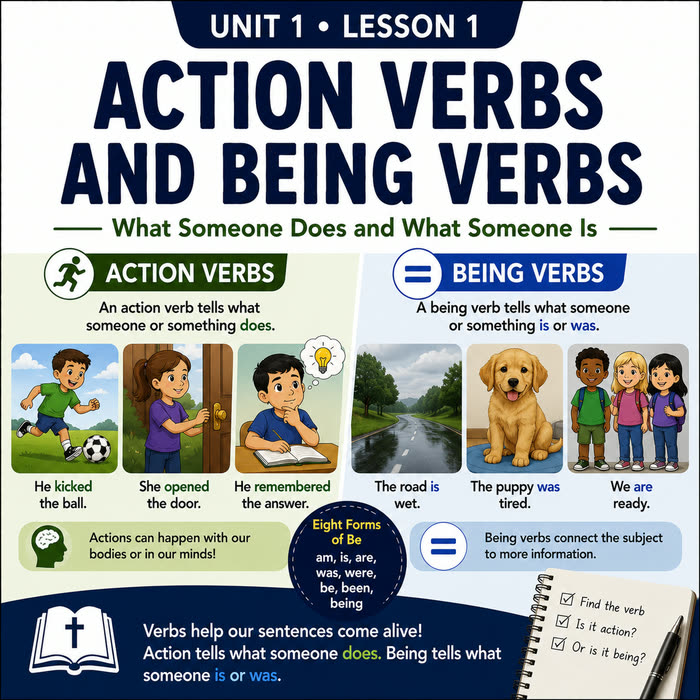 Action and Linking Verbs · U2-C10
Verbs: Action and Being
Every sentence has an engine. Find it with a test that works even when nothing happens.
- Teacher Notes: what to say when a student is stuck
- The lesson read aloud, one line at a time, highlighted as it goes
- A test the student can run alone, not a definition to memorise
- Five worked examples, then a two-part worksheet: find the verb, then name its kind
Grammar · U4-L7
Simple Subjects and Simple Predicates
One word runs the subject and one word runs the predicate. Find them both.
- Teacher Notes with the grade and a reset only the teacher can reach
- A Saturday at a small airfield, read aloud one line at a time
- The same story again with both words marked in color
- Worked examples that say how you could have known
- One part where the words are laid out, and one where they are not
Grammar · U4-L15
Forming Compound Subjects and Predicates
Two sentences that repeat each other can usually become one. Learn the fold.
- Teacher Notes with the grade and a reset only the teacher can reach
- A Saturday morning at a farmers' market, read aloud one line at a time
- The same story again with the joined parts marked in color
- Worked examples that show the two short sentences underneath the long one
- One part where you find both joined words yourself, and one where you say which half got joined
Grammar · U4-L6
Complete Subjects and Predicates
Where does the subject stop and the rest of the sentence start? Draw the line and find out.
- Teacher Notes with the grade and a reset only the teacher can reach
- A hardware store on a Saturday morning, read aloud one line at a time
- Seven sentences where you place the dividing line yourself
- Five more where the work is done and you name the half
- A printable worksheet, black and white, for doing it on paper