← History Worksheets
Download

History · Grade 8 · Worksheet

The Boston Tea Party

Read the history, then answer in your own words. Answer key on the last page.

Name Date Score

A Brief History

Britain won the French and Indian War in 1763 and came out of it holding more land in North America than ever before, along with an enormous debt. Parliament decided the colonists should help pay for a war fought partly on their behalf. That sounded reasonable in London. It landed very differently in Boston, because the colonists had no members in Parliament and had spent a century deciding their own taxes through their own assemblies.

The taxes came one after another. The Stamp Act of 1765 taxed printed paper, from newspapers to playing cards. The Townshend Acts of 1767 taxed glass, paint, paper and tea. Colonists answered with boycotts, refusing to buy British goods until the taxes were repealed, and the boycotts worked well enough that most of the Townshend duties were dropped. The phrase people shouted was no taxation without representation. Notice what it says: the complaint was not that taxes existed, but that these ones were decided by a Parliament the colonists had no vote in.

The tax on tea was the one Britain kept, deliberately, to prove it still had the right. Then in 1773 Parliament passed the Tea Act, and here is the part students usually get backwards. The Tea Act made tea cheaper, not dearer. It let the struggling East India Company ship tea straight to the colonies without the usual middlemen, undercutting even the smuggled Dutch tea Boston merchants had been living on. Britain expected the colonists to be pleased. Instead they saw a monopoly, and a trap: buy the cheap tea and you accept the tax, and accepting the tax accepts the principle.

On the night of 16 December 1773, after a mass meeting of several thousand people failed to get three tea ships sent back to England, somewhere around a hundred men from the Sons of Liberty boarded them at Griffin's Wharf. Some wore blankets and paint as a rough disguise as Mohawk men. Over about three hours they split open 342 chests and emptied roughly forty-six tons of tea into Boston Harbour. They damaged almost nothing else, swept the decks afterwards, and one broken padlock was quietly replaced. The point was aimed at the cargo, not at the ships.

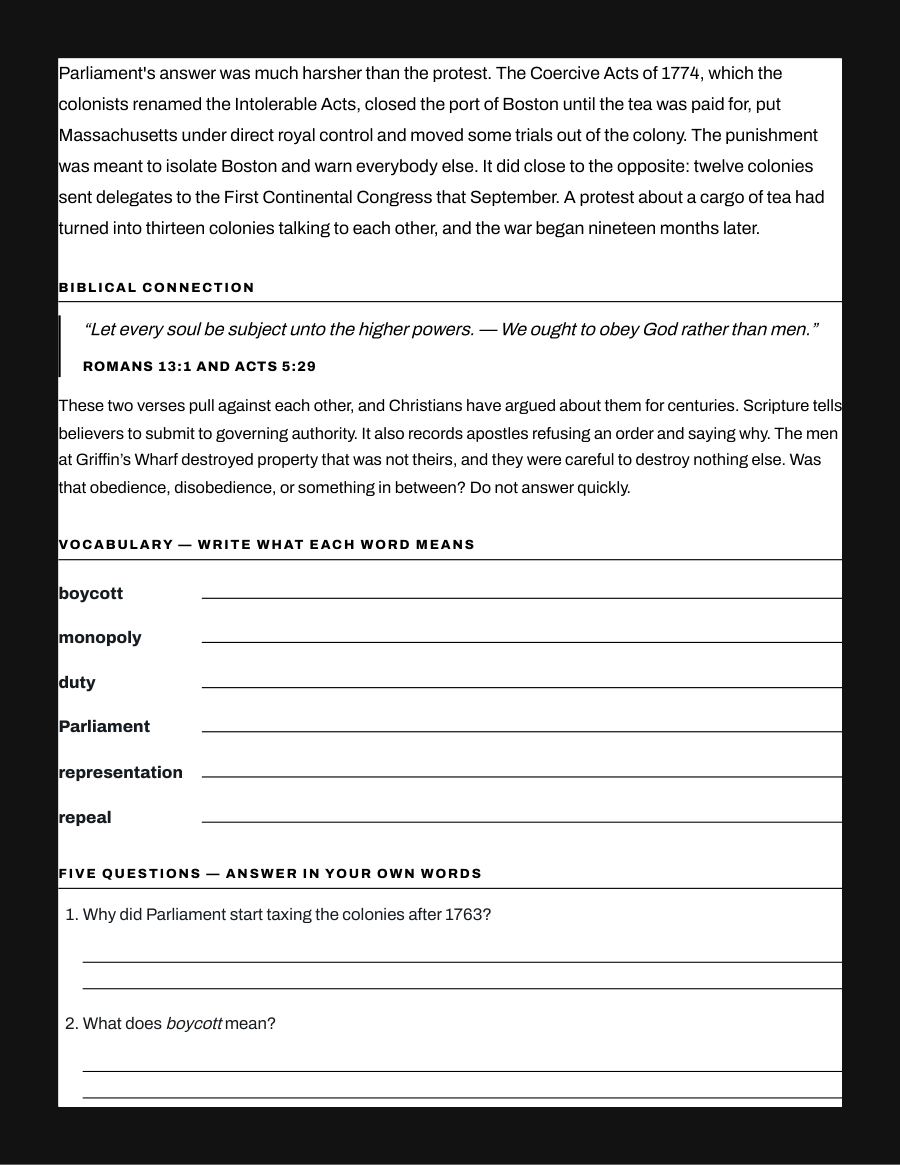
Parliament's answer was much harsher than the protest. The Coercive Acts of 1774, which the colonists renamed the Intolerable Acts, closed the port of Boston until the tea was paid for, put Massachusetts under direct royal control and moved some trials out of the colony. The punishment was meant to isolate Boston and warn everybody else. It did close to the opposite: twelve colonies sent delegates to the First Continental Congress that September. A protest about a cargo of tea had turned into thirteen colonies talking to each other, and the war began nineteen months later.

Biblical Connection

“Let every soul be subject unto the higher powers. — We ought to obey God rather than men.”

Romans 13:1 and Acts 5:29

These two verses pull against each other, and Christians have argued about them for centuries. Scripture tells believers to submit to governing authority. It also records apostles refusing an order and saying why. The men at Griffin’s Wharf destroyed property that was not theirs, and they were careful to destroy nothing else. Was that obedience, disobedience, or something in between? Do not answer quickly.

Vocabulary — write what each word means

Five Questions — answer in your own words

  1. Why did Parliament start taxing the colonies after 1763?
  2. What does boycott mean?
  3. The Tea Act made tea cheaper. Why did the colonists protest against it anyway?
  4. What does the reading say the protesters did NOT do, and what does that suggest about their aim?
  5. Britain's punishment was meant to isolate Boston. What happened instead?

Before you answer. Four of these five are hiding in the reading. Find the sentence that answers each one and write its question number in the margin beside it, then answer from the sentence you found. Question 2 is a vocabulary word, so check the word list instead.

Answer Key

Vocabulary. boycott Refusing to buy something as a form of protest.   monopoly Complete control of the supply of a good by one company or group.   duty A tax charged on goods that are imported.   Parliament Britain's law-making body, where the colonists had no representatives.   representation Having someone elected to speak and vote for you in government.   repeal To cancel a law.

Five Questions. Accept answers in the student's own words that carry the sense below. The place each answer comes from is noted, so you can check it was found rather than guessed.

  1. Britain had come out of the French and Indian War with an enormous debt, and Parliament decided the colonists should help pay for a war fought partly on their behalf. (Paragraph 1)
  2. Refusing to buy something as a form of protest. (Vocabulary, not in the reading)
  3. They saw a monopoly for the East India Company, and a trap: buying the cheap tea would mean accepting the tax, and accepting the tax would mean accepting Parliament's right to tax them without representation. (Paragraph 3)
  4. They damaged almost nothing besides the tea, swept the decks afterwards and replaced a broken padlock. It suggests the protest was aimed at the cargo and what it stood for, not at the ships or their crews. (Paragraph 4)
  5. Twelve colonies sent delegates to the First Continental Congress, so instead of standing alone Boston ended up with the colonies talking to each other, and war followed nineteen months later. (Paragraph 5)